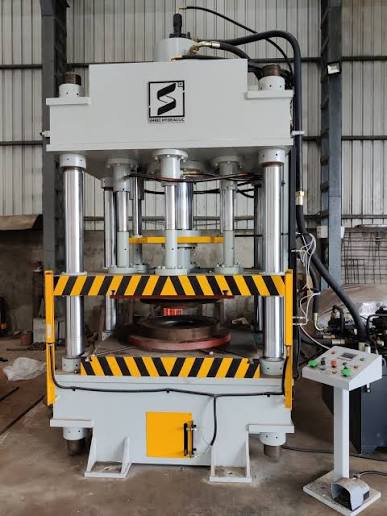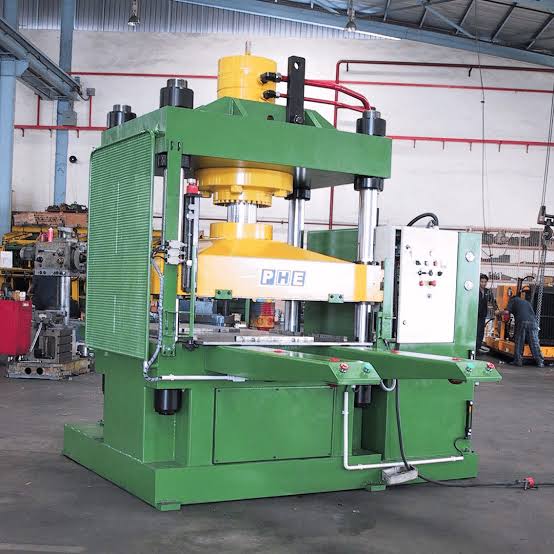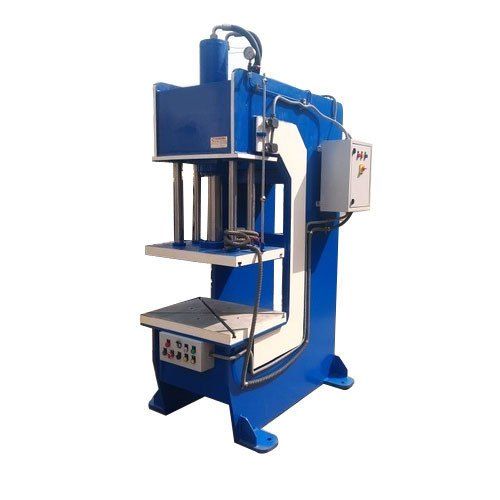
Hydraulic Presses
Controllable, full-stroke force handles deep draws, heavy-gauge forming, and straightening operations that mechanical presses can't manage. Adjustable tonnage and dwell time make the same equipment adaptable across a wide range of part geometries.
What's Included
Hydraulic presses apply consistent, controllable force through a full stroke rather than a fast mechanical impact, which makes them the right tool for operations that require sustained pressure over time — deep drawing, heavy-gauge forming, and straightening chief among them. Where a mechanical press delivers a quick, high-speed strike, a hydraulic press can hold pressure at a controlled rate for as long as the operation requires, which is exactly what's needed when forming thicker material or achieving deep draw depths without tearing or wrinkling the metal.
This makes hydraulic presses particularly suited to structural components and heavier-gauge parts where the material simply won't respond well to a fast mechanical stroke. Deep draw operations, in particular, require the material to flow gradually into the die cavity — too much force too quickly and the part tears; too little and the draw depth isn't achieved. Hydraulic control allows that force to be dialed precisely to the material and part geometry in question.
Tonnage and dwell time are both adjustable on our hydraulic press equipment, which means the same machine can be set up for a wide range of jobs — from a shallow structural bend to a full deep-draw enclosure — without needing to switch equipment. This flexibility is particularly valuable for parts that don't fit neatly into standard tooling, or where dwell time under pressure affects the final material properties of the formed part.
Straightening is another common application for hydraulic presses — parts that have warped during welding, heat treatment, or handling can often be corrected under controlled hydraulic pressure rather than being scrapped, which is a meaningful cost and time saving on higher-value components.